
A $11.6 billion industry. A 10-million-strong workforce. Zero employment infrastructure. One IIT Delhi founder who spent three years listening before he built anything.
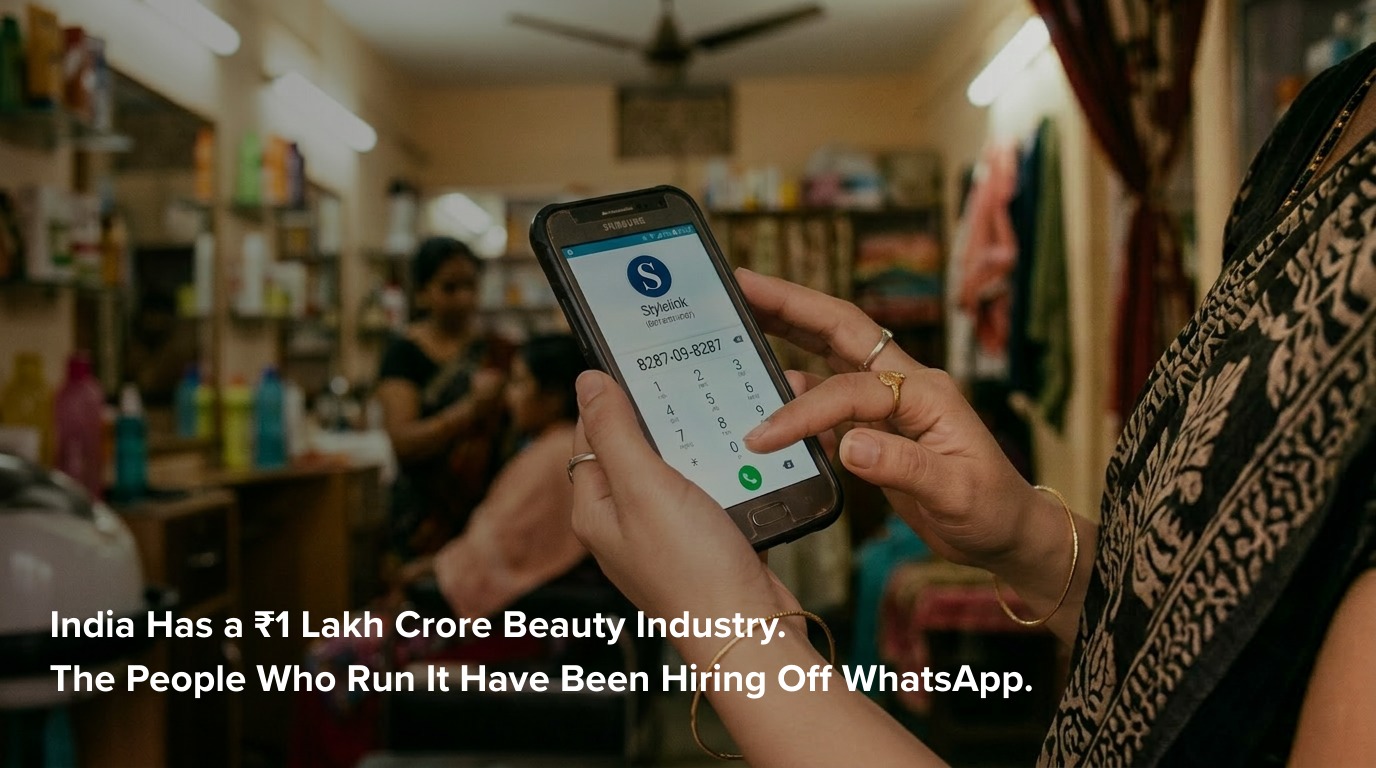
Somewhere in Patna, a young woman picks up her phone. She doesn’t open an app. She doesn’t type a search query. She dials a number, lets it ring once, and hangs up.
Within hours, she has a job lead in a verified salon three kilometres from her house.
She’s a beautician. She found work the way most of India’s beauty professionals do – not through a portal, not through a recruiter, but through something that cost her nothing and required no smartphone, no English, and no internet connection.
A missed call.
That missed call is, in many ways, the story of Stylelink – and the story of everything that was broken about salon hiring in India before it came along.
THE BILLION-DOLLAR BLIND SPOT
India’s beauty and salon industry is one of the most quietly extraordinary economic stories in the country. Valued at $11.6 billion in 2024 and projected to nearly double to $23 billion by 2033, it is growing at nearly 8% annually – faster than most sectors that get far more attention from the startup ecosystem. Over 13,000 organised salon chains operate across the country. Hundreds of thousands more independent salons, parlours, and studios make up the unorganised majority. Tier- 2 and tier-3 cities are seeing new salons open every month, driven by rising incomes, social media influence, and a generation that has decided grooming is not a luxury.
And yet at the heart of this boom sits a structural absurdity. The workforce that powers all of it – estimated at over 10 million hairstylists, barbers, beauticians, makeup artists, nail technicians, and salon assistants – has no formal employment infrastructure whatsoever.
No dedicated job platform. No salary benchmarking. No verified listing system. No way to separate a genuine offer from a fraudulent one.
Just WhatsApp groups.
“India has job portals for IT, startups, government jobs – but nothing dedicated to beauty professionals. Yet this is a workforce of over 10 million people.”
– Navneet Chandan, Founder, Stylelink
This is the gap that Navneet Chandan, an IIT Delhi engineer, decided to fill. Not because it was the obvious next big thing. Because in 2020, a pandemic made it impossible to look away.
WHAT THE LOCKDOWN REVEALED
In April 2020, India went into lockdown. The beauty industry – more dependent on physical proximity than almost any other sector – collapsed almost overnight. Salons closed. Weddings were cancelled or postponed indefinitely. Walk-in footfall disappeared. For millions of professionals whose livelihoods depended on showing up and doing the work, income didn’t reduce. It vanished.
For Chandan, the lockdown didn’t just reveal an economic crisis. It revealed something structural that had always been there. When salon workers suddenly needed to find new work – to relocate, to pivot, to find any hiring salon in any city – they had nowhere to go. The networks they’d always relied on had dried up. The informal agents they’d trusted had nothing to offer. The WhatsApp groups had gone quiet.
The beauty workforce was not just economically vulnerable. It was invisible to the very infrastructure that might have helped it.
10M+ beauty professionals in India with no dedicated employment platform
Chandan began to map what he was seeing. Professionals finding jobs through friends-of-friends. Agents promising ‘guaranteed placement’ and collecting fees with no accountability. Relocation decisions made on the basis of a single phone call, with no salary confirmation, no verified employer, and no recourse if things went wrong.
The more he looked, the clearer it became: this wasn’t a gap waiting to be filled. It was a failure waiting to be named.
THE FIRST ATTEMPT – AND THE HONEST RECKONING
Stylelink launched its first mobile app around three years ago. It was, by most conventional measures, a well-built product. Clean interface. Strong features. Built by engineers who knew what they were doing.
It struggled.
The problem wasn’t the technology. The problem was that the team had built for a user they understood in theory but not in practice. A large segment of India’s beauty workforce – particularly in smaller cities – wasn’t navigating complex apps. They weren’t accustomed to the kind of digital self-service experience that the app assumed. They had been left behind by a decade of Indian tech products designed, implicitly, for the urban middle class.
“We overbuilt. The product was too advanced for the ground reality. We had built for how we thought they should behave – not how they actually did.”
– Navneet Chandan, Founder, Stylelink
This kind of honesty is rarer than it should be in startup culture, where the impulse is always to push harder, raise more, and grow through the problem. Chandan did something different. He paused. He went back to the people the product was supposed to serve. And he started, really, from scratch – not on the code, but on the understanding.
THE MISSED CALL THAT BECAME A RESEARCH ENGINE
The pivot came from an insight simple enough to be overlooked: if the product couldn’t reach the people who needed it most, the answer wasn’t a better product. It was a different channel entirely.
Stylelink introduced a missed call number – 8287-09-8287. A beautician in a small town with a basic handset and a prepaid SIM could give a missed call. No data connection required. No app to download. No form to fill. No English needed. The team would call back, onboard them manually, and add them to the platform.

What followed surprised even the founders. Over the next three years, more than 2.5 lakh professionals registered this way. Not because of a viral campaign or a marketing budget. Because a missed call was something they could actually do.
2.5 Lakh+ professionals registered – the majority via a single missed call But the missed call number was never just a growth hack. Every callback was a conversation. Every conversation surfaced something the platform needed to know: what these professionals actually valued, what had gone wrong in their past hiring experiences, what they were afraid of, what they were looking for. For three years, while the broader tech ecosystem was busy building for Bandra and Bengaluru, Stylelink was building a dataset – and a relationship – with the Bharat that everyone else had missed.
By the time the company was ready to rebuild its app, it had onboarded over 4,000 salons across more than 250 cities. It understood the difference in hiring dynamics between a senior colourist in Chennai and a fresher beautician in Muzaffarpur. It knew that tier-2 cities were growing faster than metros, and that the assistant and fresher market – professionals entering the beauty workforce for the first time – was enormous and almost entirely unserved.
4,000+ salons onboarded across 250+ cities before the app relaunch
BUILT FOR BHARAT, NOT FOR BANDRA
The rebuilt Stylelink app launched in 2025. This time, the design philosophy was inverted. Instead of asking how much the platform could do, the team asked: what is the minimum friction required for a beautician in Patna to find a verified job in under five minutes?
The answer shaped everything. City-wise and category-wise search. Verified salon listings with transparent salary ranges displayed upfront – because Stylelink’s own research had shown that salary transparency was more valued than any other feature. Direct hiring with no middlemen, no agents, no fees extracted from candidates. An interface designed to function for users who are not fluent in English and not confident with smartphones.
And underneath all of it, an AI layer that most users would never consciously notice – but would feel. Job recommendations matched to each professional’s specific role, location, and experience level. AI-ranked candidate shortlists for salon owners, so the best-fit applicants surface first rather than the most recent. And a multilingual voice search capability that means a stylist in rural Tamil Nadu can find a job by speaking into her phone in Tamil – no typing, no searching, no literacy barrier.
“We are not building for metro elites. We are building for the real workforce – the people who actually power India’s beauty industry.”
– Navneet Chandan, Founder, Stylelink
The relaunch found an audience immediately. Within weeks: 10,000 app downloads. Active hiring across Bengaluru, Hyderabad, Delhi, Chennai, Mumbai, and Pune. And rapid adoption in precisely the markets that validate the thesis most – Kozhikode, Patna, Mangalore, Jaipur, Ahmedabad. Cities where structured salon hiring had never existed in any form.
THE SHORTAGE NOBODY IS TALKING ABOUT
There is a number buried in industry research that should be alarming to anyone watching the Indian beauty sector. According to the National Skill Development Corporation, India currently faces a shortage of 1.2 million trained beauty professionals. At the same time, government data shows the Ministry of Skill Development aims to train over 200,000 individuals in beauty and wellness annually under PMKVY.
The supply, in other words, is being created. The infrastructure to connect that supply to demand – to get trained professionals into the right salons in the right cities with the right salary expectations – barely exists.
This is the market Stylelink is positioning itself to own. Not as a listings board that happens to cover beauty, but as the connective tissue between a growing trained workforce and an industry that is expanding faster than it can hire.
The company also operates Lokaci Pro, a salon CRM platform, creating an operational presence on both sides of the equation simultaneously. Salons that use Lokaci Pro to manage their business become natural Stylelink hirers. Professionals placed through Stylelink feed back into the Lokaci Pro ecosystem. The flywheel is deliberate and structural.
THE METRIC THAT ISN’T DOWNLOADS
Chandan talks about the beauty industry with a specificity that doesn’t come from market research. It comes from three years of phone calls – from the barber in Surat who was relocated to a city that turned out not to have the salon he’d been promised, from the beautician in Nagpur who worked for three months without pay because she had no way to verify an employer before accepting the job, from the makeup artist in Jaipur who had never once in her career seen what the person in the same role across town was earning.
Behind every one of those stories is a family. A rent payment. A child’s school fees. A decision that seemed like an opportunity and turned into a trap – because the informal system that dominates salon hiring creates exactly that vulnerability, over and over again, for millions of people.
Structure creates safety. Transparency builds trust. Infrastructure creates dignity. These aren’t marketing lines for Stylelink. They are the actual reason the company exists.
“Until now, nobody thought of beauty as a real career. We want to change that.”
– Navneet Chandan, Founder, Stylelink
There is a version of the Stylelink story that is purely about market opportunity – and it is compelling. An $11.6 billion industry doubling by 2033. A shortage of 1.2 million trained workers. A workforce that has never had a platform of its own. The numbers are real, and they are large.
But the version of the story that matters more is about what happens when a hairstylist in Kozhikode opens an app and sees, for the first time, exactly what her skills are worth. When she can verify the salon she’s considering. When she can search for jobs in her own language by speaking, not typing. When she knows that the offer she’s looking at is real.
That is what Stylelink is building toward. Not the biggest platform in India. The most trusted one for a single industry. The one that actually speaks the language of the people who need it most.
In 2020, a lockdown made the problem impossible to ignore. In 2021, a missed call proved the demand was real.
In 2022 and 2023, 2.5 lakh professionals proved that this workforce was ready.
In 2025, a rebuilt platform is turning three years of listening into infrastructure.
India’s beauty workforce has been waiting for someone to build this. The question, for a long time, was whether anyone was paying enough attention to notice.
About Stylelink
Stylelink is India’s first dedicated employment platform for salon and beauty professionals, operated by Lokaci Innovations & Technologies Private Limited. With over 2.5 lakh registered professionals, 4,000+ onboarded salons, and active presence across 250+ cities, the platform connects hairstylists, barbers, beauticians, makeup artists, nail technicians, and pedicurists with verified opportunities – without middlemen. Lokaci Pro, the company’s companion CRM, serves salon businesses with operations and workforce management tools.
